partial_accumen

joined 2 years ago
[–] partial_accumen@lemmy.world 1 points 5 hours ago

Well, you'd then have another problem. Unlike coal/wood/oil fuel, you can't turn off radioactive decay.

You'd have megawatts (gigawatts?) of thermal energy boiling off all your water pretty quickly, and likely eventually melting down your steam engine firebox, and it would be that hot for decades!

[–] partial_accumen@lemmy.world 7 points 6 hours ago (3 children)

if we stuck a suitably shaped non-critical amount of plutonium in the firebox.

Non-critical? There isn't much energy released from natural decay compared to criticality. We created things like this to power space probes like the Voyager I and II craft. 4.5kg of this Plutonium created about 2500w of thermal energy the the beginning of its life and the power declines from there.

source

[–] partial_accumen@lemmy.world 9 points 6 hours ago (6 children)

Hydro isn't. Nor is solar photo voltaic, wind, or tidal, but yeah, nearly everything else is. In a combined-cycle natural gas or diesel plant half of the power generated isn't steam power, but the other half is.

[–] partial_accumen@lemmy.world 12 points 10 hours ago (5 children)

Also, air resistance was acting on the baby immediately after it left the hands accelerating it. So was she reporting peak speed or the speed several feet away as shown in the frame of the comic. Additionally, she could have easily avoided this ambiguity if she stated the hypothetical speed of the baby being as if it was thrown in a vacuum, but she didn't do that either. Its just pure laziness really.

[–] partial_accumen@lemmy.world 16 points 10 hours ago (2 children)

It also put Sainz in the top 10 in the Drivers championship. So both Williams drivers are in the top half in the Drivers Championship, and Williams as a team is in the top half in the Constructors championship. I love how great they are doing this year, especially when they are running their 2024 car!!

[–] partial_accumen@lemmy.world 0 points 1 day ago* (last edited 1 day ago)

Warning incoming wall of text!!!!

There are two things I'd recommend you give some consideration to altering from what you described as your current path so far:

#1 Don't go for an IT degree

You have decades of experience in IT. You are going to learn very little from trying to get a degree for an area of expertise you already know. Yes, you'd be able to test out of a bunch of stuff, but in the end you're still going to have to take lots of classes that will be boring for you or worse, you'll have to "learn it wrong" because of the gap between academic answers and what we both know from experience is how it works in the real working world. From my previously aborted attempt at college after high school I knew "getting bored with classwork" was one of my weaknesses. Pushing myself to do work I knew was useless or wrong is a large part of why I think I failed to complete the first time. You may or may not have the same issue as I did. At best, if you are successful getting an IT degree, you'll likely have learned little to nothing more than you know now.

Consider instead getting a degree in an area you don't know backwards and forwards already. I chose the business/marketing path. There are a number of reasons I liked this path:

  • The coursework is not generally difficult compared to technical IT material you and I have to consume on a regular basis for work. As I was doing full time IT at the same time, it was a really nice change of topic to be able to do coursework without getting more IT to deal with. It made it something to look forward to instead of dreading.

  • Having the business education gave me fantastic view of what the organizations I was working for were trying to achieve with IT, where the challenges existed we have almost no visibility to in IT, and the ability to speak the language of business to C suite executives while fully retaining all of my IT knowledge I already knew. This business communication ability alone I can point to for several specific instances where I was later successful in an IT objective because I was speaking their language.

  • As for the worry about having a degree not in IT, nobody cares what you get your Bachelors degree in. Employers always assume you did it after high school anyway, instead of as a mature adult. They just want the "degree" box checked for the hiring requirement. If you truly want a degree in the field you work in, do that as a graduate degree. There, it matters.

  • Its cheaper to get the degree! Business and marketing classes are available from far more schools on far more frequent schedules. This means you can shop on price for your school with far more schools to choose from and things like lab fees and textbooks were generally cheaper too.


#2 Don't go to WGU as your school of choice

WGUs business model, as I'm sure you're aware, is different than most schools. Instead of a "per credit hour" fee, you pay a flat fee "per term" that allows you to take all the classes you can handle. However, that flat fee requires nearly a full-time student course load to break even compared to other "per credit hour" schools. One the surface its a good deal. If you were quitting your full time job, I might recommend it. Instead, if you're keeping your full time job that means you're going to be paying FULL PRICE per term, but only able to take advantage of a small fraction of that high cost.

#3 Costs (bonus unsolicited advice!)

Avoid taking on debt for school! I'm hopeful that your employer has some sort of tuition reimbursement. Many do! Check into that and find out what the terms and conditions are. Though many have a golden handcuff clawback provision, they are usually limited to 1 year. So if your degree takes you 3 or 4 years to complete part-time, you quit your job immediately upon graduation, at worst you only pay back 1 year's costs. Further, if you're laid off you don't even have to pay back that 1 year! For whatever isn't covered, pay out of pocket if you can. This is also why choosing a cheaper school is important. You're at an age you should be contributing heavier to retirement, not taking on student loan debt (again if you have the luxury to avoid it).

I'm not sure if you have done much if any college before, but if you have, its entirely possible that any courses you passed can still be applied to your new degree attempt. I had credits that were over 17 years old (English, History, Math) that fully applied to my new degree saving me time, money and effort. You'll find out all of this when you pick a school and have your first talk with your assigned advisor.

As for picking a school, this part of the advice may be out-of-date so take it with a grain of salt. Avoid "online only" schools. These target people just like you that are working adults, but they charge a high premium because they know you have money. There is also a bit of a stigma with employers for some of these schools. Most state support schools which are bricks and mortar offer many online-only degrees. This means you can get a mostly or entirely online degree, from an actual accredited (seek regional accreditation only! "national" accreditation is a scam!), while getting low cost schooling from a school that is established and recognizable to employers as legitimate.

Select your 4 year school, and see which Community College credits they accept. Community college be the least expensive courses you can find, and have your advisor at the 4 year school confirm these CC classes transfer 100% into the 4 year school. Your Bachelors degree will say the 4 year school name. Nobody asks or cares where you completed your pre-req courses. Don't pay high 4 year school prices when you can pay cheap 2 year school class prices! Also, frequently there is an Associates degree with 100% overlap with your Bachelors school. This means you can achieve a 2 year degree without having to spend all the time for bachelors before you have something to show for your work. I got a 20% pay raise with a better job just from my prior IT experience and my new Associates degree in business/marketing.

If I may be so bold, here's your homework for next week:

  1. Find out what tuition reimbursement options your employer has. Its also possible they have preferred rates for specific schools so you need to find this out first.
  2. Select your degree.
  3. Select your 4 years school, and search their website for what 2 year/community college they partner with for full credit transfer.
  4. Contact your school of choice through their admissions process, and get assigned an advisor (all this is free). They will be able to set up a meeting with you and walk you through the next steps after you communicate your goals with the school. You will come out of that meeting with a Plan of Study which is a document that tells you what classes you'll need to take, the info required to calculate the approximate total cost of your degree, and give you a good idea of the time to complete it.


100% of the above homework steps have ZERO COST and ZERO COMMITMENT! There is no reason for you to NOT do these things as these are the critical answers of evaluation info I was missing when I was taking too long to get going. The very first time you have cost or commitment is when you enroll in your first class. Start with just one. Use that to get in the grove with what school will demand of you. After than you can ramp up the number of courses at once. Again, I did a regular load of 2 courses at once as I found 3 to be too many.

I hope this is helpful info. If this was too much info, my apologies. If you have other questions, feel free to ask. I want you to be successful in this!

[–] partial_accumen@lemmy.world 1 points 1 day ago (2 children)

At the time I was sure it was the architecture and planning I enjoyed, so I accepted a position as an Architect with another company. In the end though, I realized that it wasn’t the technical work I enjoyed, it was mentoring and building a team. It felt great to be the guy who could help take the ideas that the team had, and build them into a workable business solution. I even enjoyed bringing my engineers back down to ground level; sometimes a really good idea, just isn’t workable in the current landscape.

You are ready and qualified for a management position right now. This is most of what I would want to hear if I was interviewing you for a leadership role.

I know a degree won’t fix every problem, but at this point, working on new ones is what I’m after.

A degree fixes one single problem that I couldn't overcome any other way: meeting the requirement of having a bachelors degree which employers require. It will do the same for you.

I’m in the evaluation stage, trying to make sure I can stick to it if I embark on this journey. Discussions like this help a great deal.

I stayed in the evaluation stage for far too long. There are steps a few into the process which require actual commitment. The first few steps don't. Do those first few starting next week. What I found was that I was missing critical information for my evaluation I couldn't get any other way beside action.

If you're interested I'm happy to share more tactical knowledge and experience about what to do next as a mature working IT professional wanting a degree. Let me know if you're interested in that.

[–] partial_accumen@lemmy.world 1 points 2 days ago (4 children)

I joined the IT workforce during my generals at college, before the .com crash in the 90’s. I dropped out and have been working my way up ever since. I’ve led teams, I’ve been an architect, I’ve been a senior engineer,

You and I were on much the same path at about the same time.

the door is closed unless I have the degree.

I saw this same thing as I was advancing. I made the hard (at the time) choice to keep my full time IT role and go back to school part time at the same time. I did part time three years Community College getting an Associates Degree. While not the director level, it did get me a better, higher paying, job. My new boss actually called out that degree as working in my favor to get the position. That company had tuition reimbursement, so while working that full time IT role, I took advantage of that to attend a university part time, and after another 3 years got my Bachelors. My Bachelors degree got me a more advanced role yet at a new org. That lead to far more advancement.

Here's the good news. University work will be easy for you! You've grown into an adult with organizational skills, an awareness of your responsibilities, and time management skills. It will be significantly easier for you now, as an adult, than an 18 year old that doesn't understand life yet. So I encourage you to do it! Figure out your degree program you want, and get a Plan of Study from a school. Enroll in a single course and see how you do. I think you'll be surprised how manageable it is. Its time consuming, yes, but you'll find the time. I kept to taking only 2 classes at a time, only term did I do 3 and it almost wrecked me while still doing my full time IT job.

I’m not after Fortune 500, I’ll go be a director for a balloon manufacturer or something, just a role where I can have a little of my own agency.

I,m not sure this place you're imagining exists the way you're describing. Each level up just trades for a different yoke to bear. At the director level you could be given unrealistic KPIs to meet, or a slim budget to do so. You might find you can't achieve what you want because you can't get or keep competent staff. Even if you do everything right, market forces or regulatory change can nullify all your plans which are then made meaningless or ineffective.

As you get higher into management, firing people absolutely sucks. Keeping on dead weight/underperformers/overstaff instead of firing them means you are robbing your ability to give raises or advancement to the other workers you have that are really performing well. So you fire them, but it still sucks.

I don't say any of this to discourage you. This has just been my experience. Perhaps you'll navigate the river differently and find what you're looking for when you advance. But seriously, you can totally get a Bachelors degree, and you don't even need to quit your current job.

[–] partial_accumen@lemmy.world 60 points 2 days ago (1 children)

He is asking people for help.

Then they came for me
And there was no one left
To speak out for me

[–] partial_accumen@lemmy.world 11 points 3 days ago* (last edited 2 days ago) (2 children)

Huh, is this why I've been accused of being a bot before? I've been using the noun-verb username format since the late 1990s.

[–] partial_accumen@lemmy.world 96 points 4 days ago (7 children)

“We were supposed to be paid every 15 days. And then they switched accounting firms, and then it went from 15 days to 60,” Shane said.

A contract that has NET15 terms being unilaterally switched to NET60 is a clear violation, and that should have been the stoppage of work right there.

[–] partial_accumen@lemmy.world 19 points 4 days ago (2 children)

Its forgettable pocket change to anyone but trump. He is a petulant child that doesn't like to be told "no". An example of this is the civil judgment against him E. Jean Carroll for $5m. He could have paid it as it too was pocket change to him, but he continues to fight it to this day (and he continues to lose).


cross-posted from: https://ibbit.at/post/66094

collapsed inline media

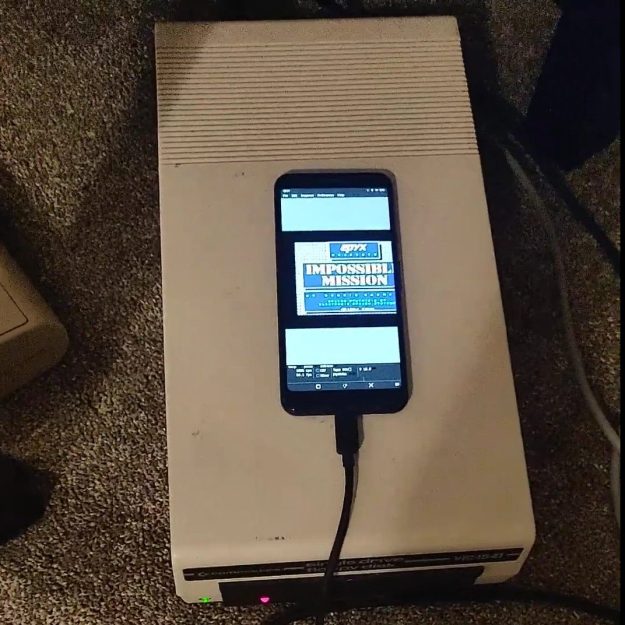
It all started with a sarcastic comment right here on Hackaday.com: ” How many phones do you know that sport a 5 and 1/4 inch diskette drive?” — and [Paul Sanjay] took that personally, or at least thought “Challenge accepted” because he immediately hooked an old Commodore floppy drive to his somewhat-less-old smartphone.

The argument started over UNIX file directories, in a post about Redox OS on smartphones— which was a [Paul Sanja] hack as well. [Paul] had everything he needed to pick up the gauntlet, and evidently did so promptly. The drive is a classic Commodore 1541, which means you’ll want to watch the demo video at 2x speed or better. (If you thought loading times felt slow in the old days, they’re positively glacial by modern standards.) The old floppy drive is plugged into a Google Pixel 3 running Postmarket OS. Sure, you could do this on Android, but a fully open Linux system is obviously the hacker’s choice. As a bonus, it makes the whole endeavor almost trivial.

Between the seven-year-old phone and the forty-year-old disk drive is an Arduino Pro Micro, configured with the XUM1541 firmware by [OpenBCM] to act as a translator. On the phone, the VICE emulator pretends to be a C64, and successfully loads Impossible Mission from an original disk. Arguably, the phone doesn’t “sport” the disk drive–if anything, it’s the other way around, given the size difference–but we think [Paul Sanja] has proven the point regardless. Bravo, [Paul].

Thanks to [Joseph Eoff], who accidentally issued the challenge and submitted the tip. If you’ve vexed someone into hacking (or been so vexed yourself), don’t hesitate to drop us a line!

We wish more people would try hacking their way through disagreements. It really, really beats a flame war.

From Blog – Hackaday via this RSS feed


So wholesome!

view more: next ›