On the other hand, if they do depart from a joyless slog from one plot point to the next, people scream "filler" like it's a crime against humanity. I do have some sympathy for people writing shows, but I agree that too many of these shows began life as single-movie pitches that were padded (or at least never edited down) rather than a traditional mini-series, which is what they are, or a season of TV slimmed down to the high-points.
wjrii
joined 2 years ago
A lot of things are possible when you have a population that is deeply socialized to believe completely in the cause, and/or has few viable economic options, and/or is literally compelled to do the work. We also have a lot of survivorship bias as the we only see the stuff that was done so well as to stand the test of time. In the early days of Egyptology for example, they would sometimes realize (or learn from the locals because the locals knew best) that the big heap of rubble over there in the desert was actually a pyramid where somebody half-assed it with mud bricks instead of the giant limestone slabs from Giza.
Got a lot of sticktuitiveness.
I don’t think I should go against the grain here.
leave things more open or unresolved or ambiguous, which is simultaneously dissatisfying and refreshing
Agreed, and it absolutely depends on the episode. Also agree that they sometimes (often?) bit off more than they could chew, but in general they weren't so disastrous that I didn't appreciate the effort. I imagine there was a lot of compromise and horse trading on those scripts, and people were probably relieved to get out something as good as they got. I like to imagine the Ferengi episodes were generally the penance exacted from writers who insisted on too much self-respect.
I've never had a BC, but I have had a sheltie, and Aussi, and a couple of Heelers. The Heelers in particular just treat you like a cow and boop and nip as necessary to make you do what they want. They are brilliant too, but not subtle and don't seem to view challenges as amusing for their own sake.
If a BC is the master thief carefully working the treasure chest with a lock-pick, the Heeler is the tank who just bashes the thing open, traps be damned, but they're smart enough to remember to chug a bunch of potions first.
I enjoyed B5 and would consider it one of the shows that did things well. The production values haven't held up quite as well (except for the prosthetics and hair, which are easily Star Trek quality I think), and I never fully warmed to either station commander, but for what it was trying to be and within the constraints of its budget, it is a really good show.
I did stop watching after the "original" finale though. I didn't see where it was likely to get any better and I wasn't quite invested enough to tolerate a significant downturn.
Those are actually becoming an artform of their own. The best ones subtly hint at the areas of focus in the upcoming episode and get your mind tee'd up.
Herding dogs assume they're smarter than humans. Border Collies are probably right.
I think DS9 and some other shows of the era really hit the sweet spot here. They were mostly contained episodes, but there were overarching narratives lurking in the background, sometimes occupying an episode or two, or a subplot here and there, blowing up around season finales and premiers, although once war broke out the ones that didn't do much to acknowledge it admittedly felt a bit out of place. That method of storytelling also forced the writers to at least consider character developments that had occurred in prior episodes and not simply ignore them in the name of the quest for syndication.
The modern format can make for some truly great TV (Andor, e.g.) and freeing up the run time without reducing the budget can mean beautiful looking shows, but they don't work well when you're basically filming an overlong first draft of a movie script, rather than writing a story (or two or three) that's meant to occupy 8-12 hours. I also agree with the others who say that a gap of more than a year (and even that much, really... it used to be three or four months) puts all but the most anticipated shows at a huge disadvantage, and god help you if you cast kids in S1.
Only if they get James Gunn to do it, and only if they can find something eye-shaped to graphically pierce.
Putting the cart before the horse a bit here, as I haven’t been writing much lately, but I got this education market ARM Chrome tablet pretty cheap and followed some instructions to get it fully converted to Linux. ChromeOS is gone. It’s running Debian Trixie via the “velvetOS” project. I could’ve just used the Linux container in chrome OS, but everything has such high guardrails that even the most minor of customizations got very frustrating. Anyway, I specifically picked the 10E because it was known to at least mostly support Linux.
Some limitations, as the camera doesn’t work, I don’t think the external speakers work (could be specific to this particular boot image), and on full boot I have to manually rotate the screen to make sure the touchscreen coordinates stay aligned with the display. Otherwise it works surprisingly well.
Firefox is probably too slow on this old MT8183 with 4 GB of RAM, but it is much faster on the EMMC install compared to the USB, and it was not torture to go online and grab a couple of files directly. The word processor is Focuswriter with their green theme tweaked to amber and it runs perfectly. Suspend/resume is working well enough with auto-login that I can just leave Focuswriter up. Battery life is an open question, but before I wiped it, Chrome OS reported it had 96% battery health 🤷. With a mobile-grade SoC, and with Bluetooth and Wi-Fi turned off, I’m optimistic it won’t be too bad.
I also fixed up one of my DIY mechanical keyboards, and I think it’s a pretty nice little writing setup. Right now, I just have Wi-Fi turned off, but I could theoretically strip out the drivers altogether, or (if I remember correctly), even take the Wi-Fi module out of this one. I opened it briefly to short out the hardware write protection on the firmware, but forgot to look for the Wi-Fi card. As an aside, this was by far the easiest I could imagine a tablet being to service — zero glue connecting screen to case.
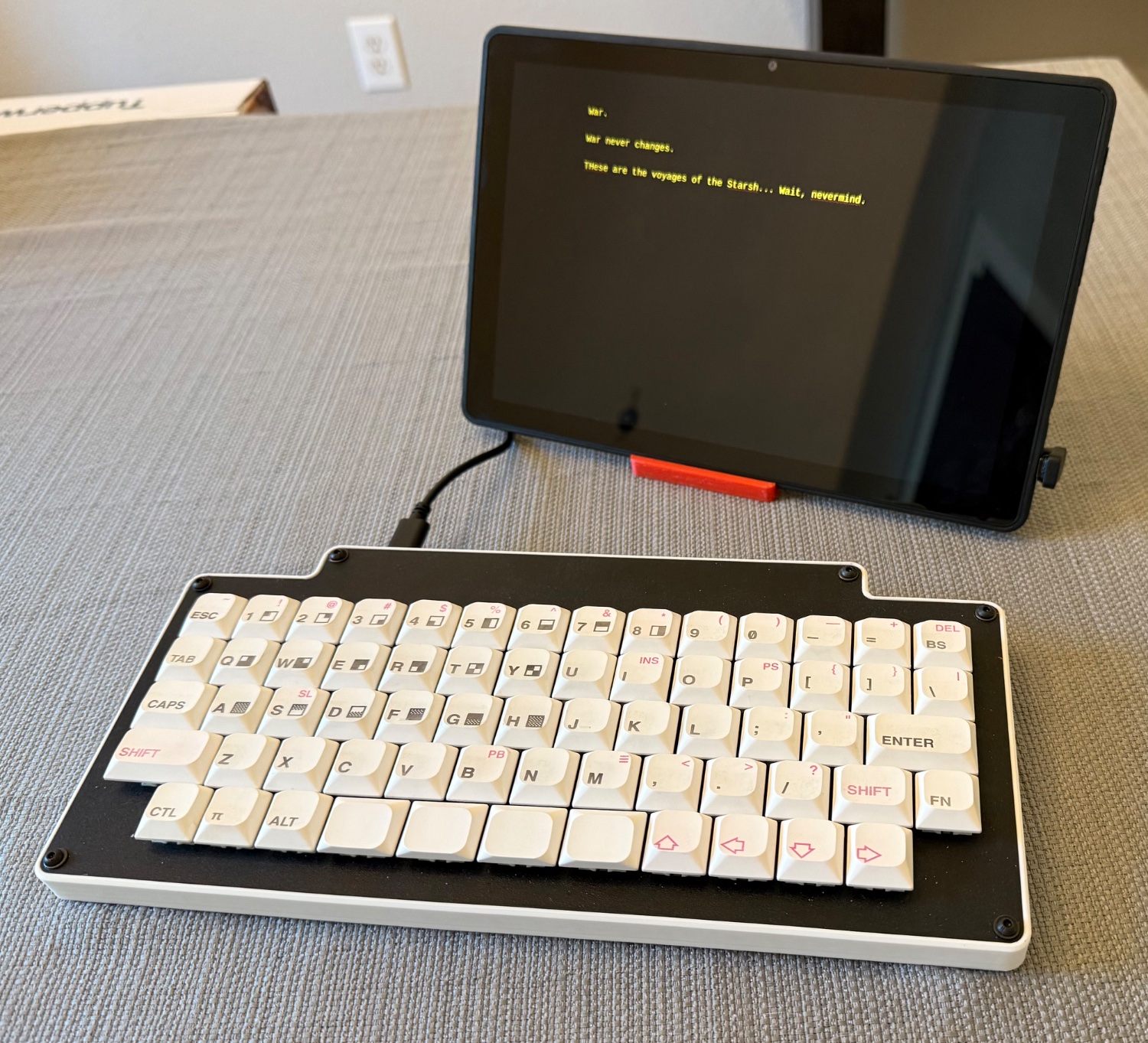
Not low effort at all!


We would also accept "Ed Zeppelin."


view more: next ›
And everyone else in the room clapped, I presume?